
Robbie Tibbons Reviewed
July 18, 2013 by Sydney Setterlund
I recently received my first review of my second novel, What Happened To Robbie Tibbons by Kym Kemp in the Lost Coast Outpost. That’s not to say it was my first review of just my second novel, but my actual first review. I guess eventually, most writers receive their first review and, if they’re lucky, it’s a good one. Fortunately, the Kym Kemp review was very good and I was happy to spread it around. I have to admit here, the review was written by a friend from childhood, but I don’t believe that factored into the kind words. At least, I don’t want to believe that was a factor and I do believe in the integrity of my friend, the journalist. So, all in all, I’m thrilled by her analysis of my story and the two young characters. While she did describe my writing as “uncertain” and “[at times] rough,” she also states that, “it perfectly captures the personalities of her characters and what it was like to swim in the scorching sun in the cool green lake. Eeriness crawls in and out of the story as Lyddy and Sally search the lake looking for a missing boy.” I also particularly liked the final sentence of the review: “From the beginning of the book, you know why Robbie Tibbons disappeared, but where he has gone and why will pull you through the darkening lives of two girls whose choices draw them farther and farther from the safe shores of childhood.” I think that sums up the book very well. And, I have to say, this evaluation of my writing and the book itself served a greater purpose for me. In my mind, it catapulted me into the realm of “real writers.” Before actually being reviewed, I felt like I was pretending to be an author, despite having written three books and publishing two of them. For someone to have taken the time to write such nice words about what I wrote makes it all seem so bona fide. If you’re interested in reading the rest of the review, find it here: http://lostcoastoutpost.com/2013/jul/13/what-happened-robbie-tibbons/ And if you’re interested in checking out What Happened To Robbie Tibbons, you can find it at Amazon in both hardcopy and Kindle: http://www.amazon.com/s/ref=nb_sb_noss_1?url=search-alias%3Dstripbooks&field-keywords=What+happened+to+robbie+tibbons
Manic Memory
Posted in Thoughts of Naught on January 12, 2011| 1 Comment »
Would you want to remember all the details of your life, including the worst of times? More so than eidetic or photographic memory, “hyperthymestic syndrome” (academic Greek for exceptional memory), is how the memory of one’s own history can be precise. According to a 60 Minutes segment, only six people in the world are known to have this total recall. Name a date and any one of them can tell you what day of the week it was and exactly what they did on that day, what the weather was and what large events (or events of interest to them) happened in the news. Of course, it all depends on if they experienced the news that day, or if there were events so extreme that it would have been unusual for them to have missed it. While the memories of personal history are retained in totality, the memory of ordinary things is not. When asked to repeat a list of words spoken to her in a predetermined order, a test subject missed many and substituted words that hadn’t been mentioned. Amazingly though, this person can recall everything she’s ever done on a day-to-day basis. Of the six known people with hyperthymestic syndrome, all show serious signs of OCD. This test subject has 50,000 pages of diary entries, which it’s thought must have assisted with the memory retention. Psychologists call it “elaborative encoding,” when every time we think of something and especially how it relates to something else, we get better at remembering it. Apparently, this test subject spent the majority of her life reflecting on the past, constructing timelines and lists and making connections from one date to the same date of the previous year. According to Gary Marcus, Cognitive Psychologist at NYU, this is the OCD of memories. “The truth is, most people could remember their lives in considerable detail if they contemplated them with the same manic intensity.” I find hyperthymestic syndrome fascinating; however, I lean more toward wanting to forget than remember. I like that my memories are softened with time, seemingly happier than reality would suggest. I like remembering the best of times and forgetting the worst. I see no reason to develop super-memory; however, I would like to remember everyone’s names and what I was told yesterday. I’m sure there’s a happy balance in there somewhere.
High Hopes For JB
Posted in Thoughts of Naught on November 8, 2010| 1 Comment »
Three cheers for Jerry Brown! Pleased with the election outcome, I decided to google JB. I was surprised to learn so much about him in just a short amount of time. What a life he’s led. Just the highlights: Brown, one of only four father/son governors ever in the US was born in 1938. At age 72, he is the oldest and was also the youngest governor of California at age 36 in 1974. He was exactly half his current age the first time he was elected. No other “modern” California governor has served longer than Jerry Brown. (I don’t know what they mean by “modern.” It wasn’t clear.) In 1990 California voters passed a law limiting governors to two four-year terms, but Brown’s prior service was not counted under the new law because he was elected and served before the law was passed. Only Deukemejian could conceivably serve as much or more than Brown, being the only other living governor serving before the new limit law, if he were to run and win again. It’s likely that Brown will always be the only “modern” California governor of more than eight years. Before law school, JB went through a Jesuit seminary and actually took vows of poverty, chastity and obedience. This was before Linda Ronstadt. During his reign as governor, Brown appointed more women, Asians, Latinos and African Americans to high government positions than any other chief executive. After being defeated by Pete Wilson in 1982, Brown led delegations to China and the Soviet Union, studied Spanish in Mexico, spent six months in Japan studying Japanese culture and Buddhist practice, worked with Mother Teresa in India and traveled to Bangladesh as a CARE ambassador of good will during the devastating floods of 1988. While running for president in 1992, Jerry refused contributions of more than $100 and used an 800 number to raise funds. Jerry Brown has been married once, to Anne Gust in 2005. What a man.
A Few Fun Facts Of Animal Anomalies
April 22, 2011 by Sydney Setterlund
I saw somewhere that snakes can see through their eyelids and that they never stop growing, which is why they need to shed their skin. This made me curious about other animal anomalies and oddities. I did a bit of research and came up with the following facts. In Switzerland, twenty-eight cows leapt off a cliff over a three day span. There is no known cause for this action. In Jatinga, India, hundreds of birds from several different species dive to the ground to commit suicide every year. It is believed by Indian scientists that atmospheric conditions in Jatinga confuse the birds, which causes them to lose their sense of direction and fly straight down, crashing into the ground. Another interesting fact was discovered when scientist viewed aerial photos of cows grazing. All of the cows faced the same direction when eating, either north or south. It is believed that it has something to do with the earth’s magnetic field, which the cows are able to detect. Why they face the magnetic pull when eating is anyone’s guess. Most animals (and toads) have the ability to predict earthquakes. Some can even know of an imminent earthquake a week in advance. The animals will evacuate the area where the earthquake eventually hits. Some other interesting facts about animals are that beavers can hold their breath for forty-five minutes underwater and a hippopotamus can stay underwater for thirty minutes. Polar bears are left-handed and a crocodile cannot stick out its tongue. Flamingos eat with their heads upside down in order to strain the water out of their food. They are pink because their main source of food is shrimp. The huge rock python of Africa is known for eating whole crocodiles and even children. Finally and maybe most interesting is the Turritopsis Nutricula, a jellyfish that is essentially immortal. It reaches adulthood and then transforms back into infancy and begins its life again. Old age cannot kill it, although it is still susceptible to disease and fatal injuries.
Punctuation: To Be Or Not To Be
Posted in Thoughts of Naught on June 21, 2011| 3 Comments »
Born in 1933, Charles “Cormac” McCarthy has written ten novels, as well as plays and screenplays. He has received the Pulitzer prize for The Road and is regularly mentioned as a candidate for the Nobel prize in literature. His influences are Herman Melville, Flannery O’Connor, Fyodor Dostoevsky and, most especially, William Faulkner, but he has the most original style of writing that I’ve ever seen. He uses capital letters, periods and the occasional comma or colon, but never semi-colons or quotation marks. He says that he doesn’t like to “blot the page up with weird little marks.” I imagine that there have been at least a few authors who also wrote without complete punctuation, but I believe McCarthy has a style all his own. In 2006, The New York Times Magazine conducted a poll of authors and publishers to determine the greatest American novels of the previous quarter-century. McCarthy’s Blood Meridian placed third. Generally four to seven years between novels, McCarthy is more about quality than quantity. And not a fan of authors who do not deal with issues of life and death, he stated, “I don’t understand them. To me, that’s not literature. A lot of writers who are considered good, I consider strange.” Personally, I’m a huge fan. All The Pretty Horses is one of my favorite books and No Country For Old Men is a great movie that follows the book almost precisely. Not that I could ever write without punctuation (I’m hopeful that my book has all the correct punctuation in the appropriate places), but I wonder about authors who have that desire. Are they allowed to write in a style that is so definitely Cormac McCarthy’s? Or does the man own his style in a way that precludes others from following suit? Can one be an original writer and write without punctuation? Or is that forever the stamp of Cormac McCarthy?
Camping Out
Posted in Thoughts of Naught on May 27, 2011| 2 Comments »
I wasn’t too concerned when Harold Camping predicted the end of the world on May 21st, 2011. In his prediction, Camping said 200 million Christians would be taken to heaven and the rest of us, well, we’d be SOL. When the day came and went without any apocalyptic action, Camping apologized for not having the date “worked out as accurately as I could have.” Now, this is not the first time Camping has predicted the end of the world as we know it (and, apparently, it’s not to be the last). He previously predicted the Apocalypse would come in 1994, but later said his math was wrong. This is a man who has a major math malfunction. According to Camping, instead of the rapture, May 21st turned out to be “a spiritual judgment day, which places the entire world under Christ’s judgment.” With the math corrected and the Apocalypse again scheduled, Camping reports a five month discrepancy in his calculations. The planet will cease to exist on October 21st, 2011. Camping did not give away his vast fortune or possessions before May 21st in anticipation of the rapture as so many followers did. As much as I refuse to take these predictions seriously, I’m beginning to get annoyed. Too many followers do take the apocalyptic predictions seriously and they keep wiping out their financial status in order to be prepared for the rapture. Camping is taking advantage of their faith and reaping the monetary benefits. I’m tired of this man leading the pack and getting news coverage to do it. It’s about time we ALL wised up and removed the guy from our radar. Believe me, the man is a KOOK who doesn’t have a clue about much of anything. Save your money for something really important like dental work, or car maintenance. You’ll need that while you’re here.
Memories in Autumn
Posted in Thoughts of Naught on October 8, 2010| 1 Comment »
I have flashbacks of the trip to the hospital. I have no memory of three weeks, but I can remember that ride specifically. I remember the smell, just after a rain, muddy and wet in the forest. It was the smell of earth and dirt, woods and harvests, dead leaves and falling walnuts. I remember the smell was pungent, lingering in my throat, almost as though I could taste it. I remember the noise of an off-road motorcycle, whining through the trees. Every time I hear that noise now, I’m transported in time. I remember the color; it was autumn. The photos in my mind during the autumn months are softened by the general lighting. The intensity of the summer sunlight is muted, and browned. I remember the grey of the road, the lane breakers coming at me, one by one, flashing along. I remember the sight of horses in a corralled field, slowly foraging for food. Everything looked surreal. I remember the urgency and purpose of our trip seemed so extreme in comparison to the slowness of our surroundings. I have no memory of the three weeks that follow, but I can recall the ride to the moment. I’m told I was delirious that day and yet I have such vivid memories. It’s strange to me what my mind retains and what it cuts loose. What unimportant moments that are stuck in my brain, simply fodder for flashbacks.
Why Beavers Build Dams
Posted in Thoughts of Naught on March 21, 2011| 4 Comments »
Why do beavers build dams? That’s just one of the many questions that pester me, so I made it my business to find out. Most articles will tell you that beavers build dams to create a body of water that is relatively safe for the beaver family. Since they are good swimmers, the deeper water allows them more protection against predators. While that may be true, I found another study that determined a different reason behind the dam-building beavers. Beavers pick the narrowest part of a stream to build their dams, illustrating intelligence and engineering skills. Beavers living in ponds, lakes and along rivers do not build dams. In testing why beavers build dams, dam-building beavers were captured and let loose in different environments. Burrowing in the bank and setting up housekeeping seemed to be it for those released in ponds, lakes and big rivers. Those released along streams found the narrowest part of the stream and proceeded to build dams. The “investigator” got to thinking. He set up tape recorders along the streams, lakes, ponds and rivers. The tape recorders played the sound of water rushing over gravel and rocks. In all cases, the beavers covered the speakers with sticks, gravel and mud, silencing the noise. The beavers covered the speakers until they could no longer hear the sound of rushing water. The investigators believed this solved the case of why beavers build dams and why they always pick the narrowest part of the stream. They hate the sound of rushing water and build dams to cover up the noise. “Beavers build dams because they like peace and quiet.”
Overall Outage
Posted in Thoughts of Naught on December 7, 2011| 3 Comments »
It’s amazing how I take things for granted. I’m reminded of that when they’re not around anymore. Such as the electricity. It went out at 7:00 pm on Wednesday and didn’t come back on until Sunday morning around 9:00 am. Three days and four nights of nothing but cold, cold, cold. I did some knitting and read a book, but most of the time I was huddled under a pile of blankets just trying to get warm. I did a lot of thinking while I waited. I had no heat, no hot water, no way to cook, no phone (battery was dead), no TV or music and no computer/internet and I was running out of food quickly. I rationed the two fiber bars, four bagels and cream cheese, the last bit of peanut butter and saltine crackers. Finished off my hoarded pepper jelly, too. Everything else in the house had to be cooked. While it was fortuitous that I hadn’t gone out and stocked up the fridge and freezer the day before the outage, it did leave me with very little to eat. I think it would have been harder watching a lot of food spoil, though. The lack of information was difficult, as well. Not having a phone or TV to get caught up with what was going on was excruciating. It’s taught me that I really need to have a good radio for just such occasions. I kept begging the PGE God to turn back on the power until finally on Saturday I realized that the power wasn’t ever going to come back on. This was how it was going to be forever more. Never warm, never clean, never full, and never in touch with those I love. I was sure electricity was over for me. I even cried a little. I cried a little when the power came back on Sunday morning, too. And I will never take electricity for granted again. This was the longest I’ve gone without power in my adult life and I hope to never do it again. The shower I took on Sunday was one of the best I’ve ever had. It took all the heaters about five hours to get the chill out and warm up the place, for which I am very grateful. I’m tentative, though. I have this understandable fear that it will go right back out again.
GMOs – What’s The Big Deal?
September 10, 2013 by Sydney Setterlund
I wanted to write a post about GMOs—Genetically Modified Organisms—because I don’t understand the issue against labeling for those of us who would rather not risk the possible, or even probable, side effects. GMOs are engineered seeds for faster growth, resistance to pathogens and fabrication of extra nutrients. That’s according to those who support GMOs, who would tell you it’s only beneficial and poses no larger threat than regular food. On the other hand, corn is specifically made to grow a deadly insecticide in each kernel that kills bugs. Protesters would say it’s not safe to eat. They would also state that GMOs affect ecological, economical and safety issues. They argue that the rats that were used to test the genetically modified food developed liver and kidney damage and massive tumors. Fifty percent of the males and seventy percent of the females died. Additionally, protesters would point to the insecticides which contaminates fields and the economic hardship to farmers and US exports. Unless I’m mistaken, all the protesters are fighting for is labeling on the packaging. Monsanto, who owns most of the companies that are using GMOs wants to keep them hidden and legal, so you won’t know what you’re eating. Many countries have either placed restrictions on the GMOs or have banned them outright. Africa, in Asia—China, Japan, Philippines, In Europe—Norway, Austria, Germany, UK, Spain, Italy, Greece, France, Luxembourg and Portugal, as well as Brazil and Paraguay in South America, have placed GMO restrictions. Sri Lanka, Thailand, Ireland and Saudia Arabia have entirely banned GMO growing and GM foods. The simple fix? GMO labeling, so consumers can decide for themselves. Until then, buy only USDA certified organics to ensure they are GMO free. IMHO, it’s the best bet, but that’s just my opinion. I can’t tell you for a fact that they’re bad, but I can tell you that many people want to know what’s in their food and there shouldn’t be anything wrong with that. It’s the least to ask.
NOVELS:
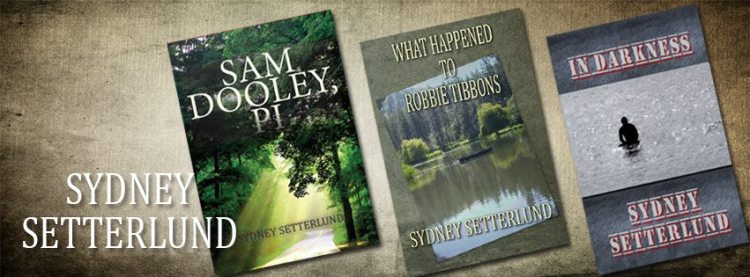
I’ve written five novels, three of which I self-published through Amazon. In my humble opinion, What Happened To Robbie Tibbons is my best book, but I highly recommend In Darkness and Sam Dooley, PI to your book club.
In What Happened to Robbie Tibbons, Sally and Lyddy are thirteen-year-old cousins, one white, one half-black, growing up in a changing era. This is the story of their summer together in 1973 when a boy changed their lives forever. It’s about doing what’s right versus doing what’s best for yourself. It’s two girls, struggling over a secret that could do them in.
In Darkness tells the story of Dean Thompson who has a great life. He has terrific friends, a nice girlfriend, a job he loves and enough money to feel comfortable. He loves surfing, running with his dog and playing basketball with his buddies. He’s sitting pretty.
But, everything must change. This is the story of how Dean attempts to cope when his life is seriously threatened. What happens affects his work, his friendships, his life.
Sam Dooley, PI is an ex-military, ex-police detective, present day PI who does most of his work with a bourbon buzz on. It helps break the monotony of his days of following husbands and wives who are screwing around on each other. His friend, Dom, calls with the news that he’s incarcerated awaiting trial on a rape and murder charge. On top of that, his sister and her two young children were just killed by a hit and run driver and Dom wants someone to pay. Sam knows he has to help. During the investigation, Sam meets Jane, who knows a lot more than she’s telling. She could be the key to finding answers, but she could also be a complication Sam wasn’t counting on.
 Sydney Setterlund